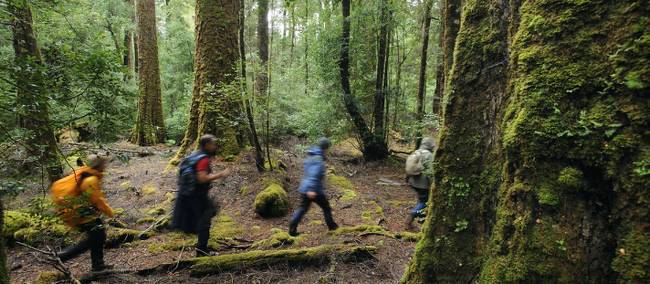
Hiking in the Tarkine rainforest | Chris Crerar

The Tarkine rainforest is a pretty impressive destination; a vast swathe of rarely visited and primal rainforests, mountain ranges and isolated rivers, it’s high on the list of any avid walker. But why is the Tarkine so special? Check out our top 10 facts about the Tarkine.
-
The Tarkine is the second largest temperate rainforest in the world and the largest temperate rainforest in Australia, with over 400,000 hectares of virgin wilderness.
-
There are three plants that are a direct link with South America’s Patagonia, New Guinea and New Zealand, with which Tasmania was connected to as part of the super continent Gondwanaland.
-
Over 2,000 hectares is covered by wet eucalypt forest areas, where trees grow to be taller than 41 metres high! These areas are said to be “large enough to be self-sustaining and support ongoing evolutionary processes”.
-
The Tarkine is home to more than 60 species of rare, threatened and endangered species.
-
The world’s largest extant carnivorous marsupial, the Tasmanian Devil, lives in the Tarkine rainforest.
-
The Tarkine is home to the world’s largest freshwater crayfish, Astacopsis gouldi, also known as the Giant Freshwater Lobster.
-
There are almost no introduced predators.
-
The world’s only known insect fossils were found in the Tarkine rainforest, found in sediments of true glacial origin.
-
Fossils between 100-700 million years old, algal stromatolite fossils, were found around the Arthur and Julius Rivers and are Tasmania’s oldest known fossils.
-
The Tarkine is a mix of rainforest, wet and dry eucalypt forest, mixed forest, riverine, heathland, moorland and coastal ecosystems.
Experience the Tarkine for yourself and join the Tarkine Explorer, this exceptional exploratory trip explores the Tarkine including a spectacular Pieman River Cruise drifting along the majestic Pieman River.